Friday, 29 April 2011

My trip to MOTAT by Deanna

This is my review of when I went to MOTAT and what I saw, experienced and learned.
I was so excited that MOTAT was giving us a free visit to help us with our project planning. When we got to the entrance of MOTAT we saw the others waiting at the tram station. We wrote on our mind map page MOTAT visit and in the same bubble we wrote ‘look at transport inventions’ and ‘look at how they were invented’. We also wrote in our positives, negatives and world issues. E.g. a positive was ‘Make work for other people’, a negative was ‘It causes pollution’ and a worldwide issue was ‘Petrol is high price’.
My group started at the cars. We had two main questions to answer-‘Why was it invented?’ and ‘how was it invented?’
There was a wheel connected to a handle and when the handle was turned the wheel began to rotate which made another wheel turn.
After the cars we went to the trams. It was the one you could climb into but not for a ride. We sat on the little seat in there and began to write. I wrote ‘It was invented because cars didn’t have enough room for heaps of people. They invented it by making a long car then putting double seats in them.’ On the way back to the main place we went to the buses which were near the trams. I learned that you should always make a model before building the real thing.’ We went into a place that had a big screen and watched a little episode called ‘The transportation of goods’ I learned that food that takes long to get to land is less healthy than food that is growing in your garden. The very last thing we visited was the bicycles. I thought it was weird how the first bike invented had a huge front wheel and a tiny back wheel just for balance. I found out the reason for this is because the pedal was on the front big wheel which meant you have to pedal less than if the wheel was smaller. Once the bicycle chain was invented both wheels could be the same size.  I also found out from Wikipedia the first bike was called a penny farthing because the big wheel was like a British penny and the small wheel was like a small farthing.
Thank you MOTAT for making this trip one of the best.

Wednesday, 20 April 2011

MOTAT review by Sufia

The Future Engineering Group went to MOTAT on the 17th April. Sarah,Yvette, Kern, Callum, James, Thomas, Deanna and I were doing this trip because we wanted to look at the affects of transport inventions in New Zealand. Here are some facts.

1. I looked at an old fashioned car called a Morris Minor. It is good at carrying stuff around places such as picnic baskets because it has a big boot, but it’s only got two seats so only two people can travel to places.

2. A man called Richard Pearse was the first man to make a modern day bike although the bike was a bit dangerous because it had a wobbly seat and the pedals are tiny.

3. The first bike was made in the 1790’s. It was dangerous because it had no steering or pedals.

4. My final fact is an invention timeline that shows transport inventions and when they were made.
1783 - Hot air balloon, 1787 – steamship, 1870 - penny farthing bike,
1885 - petrol engine,
1904 – first modern day bike

My favourite part was looking at the first modern day bike because I liked comparing the parts to our bikes at home.

Monday, 18 April 2011

MOTAT review by Sarah

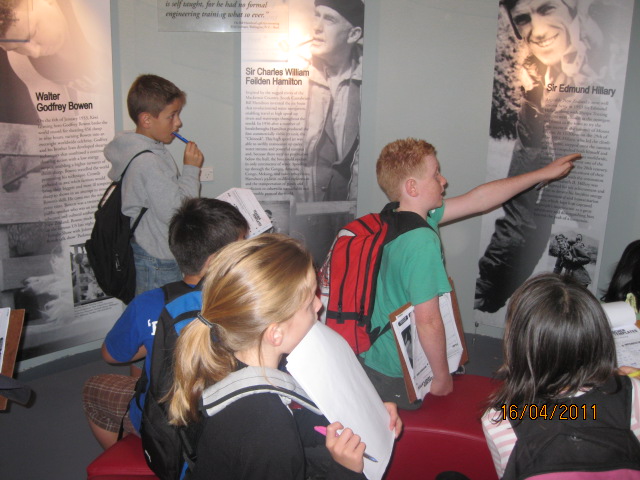
Our group organised to meet at MOTAT and have a look at the Invention Trail.
 MOTAT kindly let us visit for free. We are thinking about inventors and how they come up with their ideas for inventions in our Future Engineering group. Our group meets once a week at school and we are trying to invent a solution to the problem of traffic build up and parking issues around the school.
We looked at lots of important inventions for example:
The first plane was invented in 1903, there is debate about whether  a New Zealand farmer, Richard Pearse actually invented a “flying machine” in July of that year before the Wright brothers made their first  flight in December.
It was interesting to discover that one man, Cecil Wood built the first New Zealand motor cycle in 1895, the first New Zealand 3-wheel car in 1896 and the first 4-wheel car in 1901.
We enjoyed our trip very much, maybe someone in our group will invent something important one day!

Sunday, 17 April 2011

Our trip to MOTAT

What a great morning we had at MOTAT!
The main idea that we looked at was " The effects of transport inventions in New Zealand".

This made us think about -
1. The types and uses of transport inventions.
2. The positive impacts.
3. The negative impacts
4. Ways in which these inventions effected New Zealanders.
5. Big social issues that some of the inventions raised.


Transport inventions timeline

__c3500 BC-Wheel____1783-Hot air Balloon___1787-Steam ship___1804- Railway locomotive

___1870-Penny Farthing bicycle___1883-Electric tram___1884- Motorcycle___1885- Petrol engine

___1885 - Car

We used our this thinking to follow the inventions trail which took us to many places in the museum.


Inventions such as cars means we need to think about roads and bridges.


..and also places to park cars.


Does transport mean that we can get fresh fruit and vegetables quicker?


Amazing Kiwi Engineers.


Petrol pump

Billy T James car.

Penny Farthing bicycle


Hey, wait for me!


Tuesday, 12 April 2011

Goal of the week

Our only goal for the week will be to post a comment on

1. What you think an invention is?
2. Why do you think people invent?

This will help you on our visit to MOTAT ( Museum of Transport and Technology) this Sunday.

You will also be expected to write a review about your visit. We will be posting these on the blog as the people at MOTAT will be looking forward to reading them.

Meeting Marisha our Traffic Engineer

A big welcome to Marisha, who came and visited us in a very busy classroom on Monday! and Fiona from Futureintech. Marisha talked to us about her great job as a Traffic Engineer. She explained how Engineering can provide a passport to travel all over the world as the skills that Engineers develop are pretty amazing and so in huge demand.

Marisha went onto explain how Traffic Engineers deal with planning, design and operation of roads, streets and highways. They also help solve transportation problems like congestion which is a really big problem in Auckland or even making an intersection with a high number of crashes safer for everyone who uses them. Marisha also added that part of an Engineers job would also be to study the behaviour and habits of people using the roads like motorists, pedestrians and cyclists.

 Marisha showing us one of her current projects which is to create a busway from Botany to Panmure in Auckland.


We are all looking forward to working with Marisha next term as she will be supporting us in managing our own project as part of the Transpower Neighbourhood Engineering Awards.

Friday, 8 April 2011

What happens at our school by Sufia


Even though the sign says you can only park your car for two minutes, people do not care about the sign.